
When your business has crossed the line from surviving to thriving, it’s an incredible milestone. Business owners are great at generating revenue but often ignore the structural wealth gaps left by leaving traditional employment.
As your profits scale, choosing and optimizing the right solo retirement plan isn’t just about saving for the future; it becomes part of a critical wealth and tax planning strategy.
Your business is your most valuable asset, but it shouldn’t be your only asset. True financial freedom means converting business profits into permanent personal wealth.
For a Sole Proprietor or an S-Corp owner with no employees other than the owner and their spouse, the right retirement vehicle can supercharge your personal net worth at a rate traditional employees can only dream of.
Key Takeaways
- A Solo 401(k) can help self-employed business owners maximize retirement contributions and reduce taxable income.
- Sole proprietors and S corporation owners calculate Solo 401(k) employer contributions differently.
- A spouse who earns income from the business may also participate, potentially doubling household retirement savings.
- Working with a financial and tax advisor can help optimize retirement planning, tax savings, and IRS compliance.
Is Your Business Maximizing Your Retirement Savings?
The real metric of success is how much of the business’ revenue becomes your permanent personal property. Exploring and understanding what’s available to you is of the utmost importance. The three most common forms of self-employed retirement plans are the Solo 401(k), SEP IRA, and SIMPLE IRA. While all these plans allow you to save for your future, they have important structural differences and capabilities. The complexities of each plan are exactly why you should not set one up through a generic broker without an advisor. At DHJJ Financial Advisors, we specialize in working with business owners and helping them achieve their goals with precision.
How Does a Solo 401(k) Work?
One of the foundational concepts that surprises many business owners is that, with a Solo 401(k), you get to wear two hats: employee and employer. Because you have no employees, the IRS allows you to contribute in both roles. Like the traditional 401(k), the employee can defer up to 100% of their compensation up to $24,500 (2026 deferral limit). They can also include catch-up deferrals if of age. In 2026, this could mean upwards of $32,500. Then, you get to put on hat number two: The Employer.
How Are Solo 401(k) Contributions Calculated for Sole Proprietors and S Corporations?
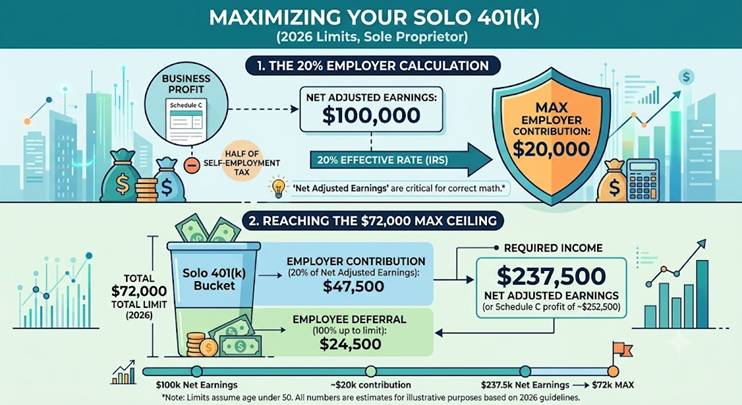
Depending on whether you are a sole proprietor or an S-Corp, the calculation is done differently. Yet another reason why working with an advisor makes a difference. If you’re a sole proprietor, your total employer contribution is 20% of your net adjusted income.
For example, if your net adjusted earnings are $100,000, the employer could contribute $20,000 to your solo 401(k). To further exemplify, reaching the full ceiling of the $72,000 max contribution (2026) after contributing the max to the employee portion, you would have to have net adjusted earnings of $237,500 of income ($24,500 employee contribution and $47,500 employer contribution).
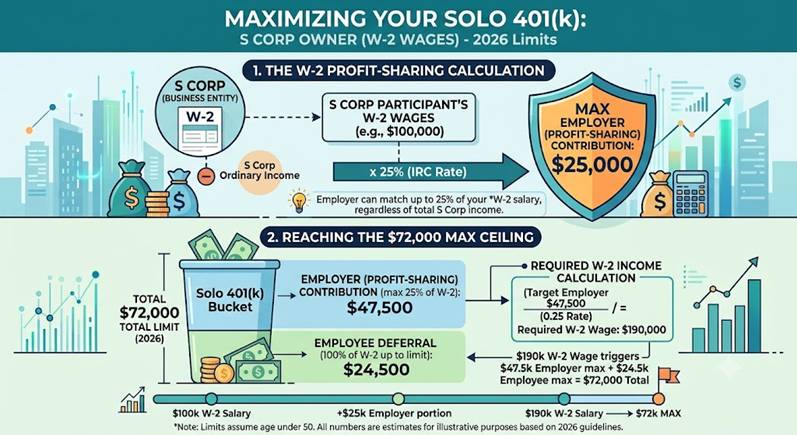
If you’re an S-Corp owner, the calculations are driven by W-2 wages rather than net business profit. The graphic below highlights the shift in how the employer contribution is calculated. While a sole proprietor is capped at 20% of net adjusted income, an S-Corp owner calculates the employer contribution by 25% of the owner’s W-2 salary.
Like the previous example, if you have $100,000 in W-2 earnings, this results in a $25,000 max employer contribution. The required W-2 income to hit the $47,500 (2026) employer target would then be $190,000 in W-2 wages.
Can My Spouse Contribute to My Solo 401(k)?
One of the most underutilized benefits of the Solo 401(k) is the ability to include a spouse who earns income from the business, opening the door to a combined household contribution of up to $144,000 (2026).
Despite its name, the plan doesn’t have to be strictly limited to a party of one. The spouse must earn actual compensation from the business, but they would get their own employee deferral limit and their own employer profit-sharing calculation based on their share of earnings. This changes the game for increasing retirement savings in your household.
When Is Form 5500-EZ Required for a Solo 401(k)?
While day-to-day administrative burdens are minimal for a Solo 401(k), crossing the $250,000 in total plan assets triggers a mandatory annual filing requirement with the IRS: Form 5500-EZ. The Form 5500-EZ is an annual informational tax return required by the IRS. It serves as an annual check-in so the IRS can verify that your Solo 401(k) remains tax-qualified and compliant.
Many business owners can overlook this filing because it is not filed as part of your personal 1040 or business income tax return. Late filings can incur steep penalties.
How to Maximize Your Solo 401(k) Strategy
A Solo 401(k) isn’t just an off-the-shelf account you can open online. It’s a powerful, multivariable tax strategy. Between balancing W-2 salary optimization against S Corp distributions, calculating sole proprietor net adjusted earnings, layering spousal strategies, and managing IRS compliance, the details matter.
At DHJJ Financial Advisors, we specialize in bridging the gap between your business profitability and your personal net worth. Our team integrates both wealth management and proactive tax expertise, ensuring your overall picture is precisely aligned with your goals. Your business works hard for you; let’s make sure your wealth strategy does the same.
Frequently Asked Questions
What is a Solo 401(k)?
A Solo 401(k) is a retirement plan designed for self-employed individuals and business owners with no full-time employees (other than you and your spouse). It allows you to contribute as both the employee and employer, often resulting in higher contribution limits than other retirement plans.
How much can I contribute to a Solo 401(k)?
For 2026, eligible business owners can defer up to $24,500 as the employee (plus catch-up contributions if eligible), with total combined employee and employer contributions reaching up to $72,000, subject to IRS rules and compensation limits.
How are employer contributions calculated?
The calculation depends on your business structure:
- Sole proprietors: Employer contributions are generally based on 20% of net adjusted self-employment income.
- S corporation owners: Employer contributions are generally based on 25% of W-2 wages paid to the owner.
Can my spouse participate in my Solo 401(k)?
Yes. If your spouse earns legitimate compensation from the business, they can participate in the plan and make their own employee and employer contributions, significantly increasing your household’s retirement savings potential.
How does a Solo 401(k) compare to a SEP IRA or SIMPLE IRA?
While all three plans help self-employed individuals save for retirement, a Solo 401(k) often offers greater flexibility, higher contribution opportunities, and additional planning features for eligible business owners. The right choice depends on your income, business structure, and financial goals.
Do I have to file any annual paperwork?
If your Solo 401(k) assets exceed $250,000 at the end of the year, you must file IRS Form 5500-EZ annually. Missing this filing can result in significant penalties.
Should I set up a Solo 401(k) on my own?
While it’s possible to open a plan through a brokerage, contribution calculations, tax planning, and compliance requirements can become complex. Working with an advisor can help ensure you’re maximizing benefits while remaining compliant with IRS rules.
How do I know which retirement plan is right for my business?
The best retirement plan depends on factors such as your business entity, income level, cash flow, long-term retirement goals, and overall tax strategy. A financial and tax advisor can help evaluate your options and recommend the most effective approach.
Please remember that past performance is no guarantee of future results. Different types of investments involve varying degrees of risk, and there can be no assurance that the future performance of any specific investment, investment strategy, or product (including the investments and/or investment strategies recommended or undertaken by DHJJ Financial Advisors [“DHJJ”]), or any non-investment related content, made reference to directly or indirectly in this blog will be profitable, equal any corresponding indicated historical performance level(s), be suitable for your portfolio or individual situation, or prove successful. Due to various factors, including changing market conditions and/or applicable laws, the content may no longer be reflective of current opinions or positions. Moreover, no portion of this discussion or information serves as the receipt of, or a substitute for, personalized investment advice from DHJJ. contained in this blog serves as the receipt of, or as a substitute for, personalized investment advice from DHJJ. To the extent that a reader has any questions regarding the applicability of any specific issue discussed above to his/her individual situation, he/she is encouraged to consult with the professional advisor of his/her choosing. Neither DHJJ’s investment adviser registration status, nor any amount of prior experience or success, should be construed that a certain level of results or satisfaction will be achieved if DHJJ is engaged, or continues to be engaged, to provide investment advisory services. DHJJ is neither a law firm nor a certified public accounting firm and no portion of the blog content should be construed as legal or accounting advice. A copy of the DHJJ’s current written disclosure Brochure and Form CRS discussing our advisory services and fees is available for review upon request or at www.dhjjfinancial.com. Please Note: DHJJ does not make any representations or warranties as to the accuracy, timeliness, suitability, completeness, or relevance of any information prepared by any unaffiliated third party, whether linked to DHJJ’s web site or blog or incorporated herein, and takes no responsibility for any such content. All such information is provided solely for convenience purposes only and all users thereof should be guided accordingly. Please Remember: If you are a DHJJ client, please contact DHJJ, in writing, if there are any changes in your personal/financial situation or investment objectives for the purpose of reviewing/evaluating/revising our previous recommendations and/or services, or if you would like to impose, add, or to modify any reasonable restrictions to our investment advisory services. Unless, and until, you notify us, in writing, to the contrary, we shall continue to provide services as we do currently. Please Also Remember to advise us if you have not been receiving account statements (at least quarterly) from the account custodian.